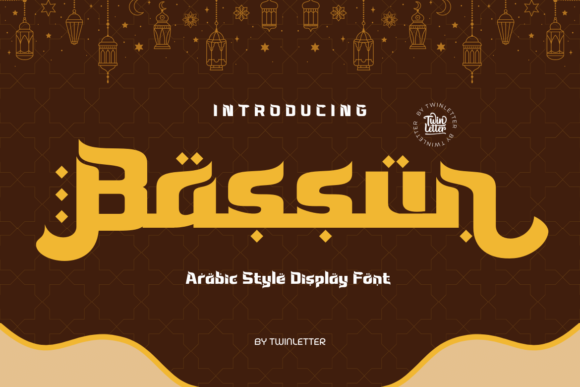
Bassun: A Premium Arabic Display Font for Modern Brands
Two weeks ago, I sat at my kitchen table—coffee cold, label printer humming—trying to print a new batch of candle jar tags for my small-batch scent shop. The old font looked fine on screen, but once printed? Fuzzy. Flat. Like it didn’t *belong* on something hand-poured and thoughtfully wrapped. That’s when I found Bassun: the new classic Arabic typeface brought to life with a digital flat pen and gothic font approach—and suddenly, everything clicked.
Bassun for Arabic Packaging Labels and Handmade Product Tags
Bassun is a Display font built for moments that matter: the first glance at your olive oil bottle, the elegant curve of your baklava box, the gold-foiled tag tied to a handmade soap bar. Because it uses a digital flat pen technique, each letter carries subtle contrast and rhythm—like calligraphy drawn with intention, not algorithm. It’s not overly ornate, but never plain. As a Fonts choice for physical goods, Bassun holds up beautifully at 10–14pt on small labels, especially when printed on matte kraft or soft-touch paper. I tested it on my candle jars (3.5cm width) and it read clearly—even under café lighting or Instagram story close-ups.
Bassun for Café Menus and Arabic Restaurant Signage
If you run a neighborhood café serving karak tea and freshly baked ma’amoul, your menu isn’t just information—it’s atmosphere. Bassun brings warmth and clarity to display text without sacrificing authenticity. Its gothic font foundation gives structure and presence, while the Arabic letterforms feel grounded and generous—not cramped or overly decorative. I used Bassun for section headers (“Freshly Baked,” “Specialty Drinks”) alongside a clean sans serif for descriptions, and customers started commenting: “Your menu feels like it belongs here.” That’s the power of intentional typography: it tells people your brand pays attention—to flavor, to craft, to detail.
Bassun for Wedding Invitations and Elegant Branding
When my cousin asked me to help design her wedding stationery (yes, I’m the “design friend”), I knew right away: this wasn’t the moment for generic Arabic fonts. She wanted tradition with quiet confidence—not flashy, not stiff. Bassun delivered. As a Display font, it shines in short, meaningful phrases: names, dates, venue lines. Its letters have a beautiful aspect—balanced weight, open counters, graceful terminals—that reads as both timeless and contemporary. For printed invites, I paired Bassun with a light serif for body text and kept spacing generous. No ligatures needed—just clarity, dignity, and calm elegance.
Bassun for Social Media Graphics and Arabic Instagram Stories
Let’s be real: your Instagram grid is often the *first* impression. And on mobile screens, every pixel counts. Bassun works so well here because its gothic font structure ensures legibility even at tiny sizes—and its Arabic character set renders crisply across iOS and Android. As Fonts go, Bassun doesn’t blur or thin out when scaled down for story stickers or quote graphics. I use it for Arabic captions over product photos (“Hand-poured • Small batch • Made in Amman”), always in bold weight, always centered. It adds authority without shouting. Bonus: it pairs effortlessly with minimalist layouts—no competing elements, just voice and vision.
Bassun for Logo Design and Boutique Brand Identity
Your logo lives everywhere—on packaging, receipts, delivery bags, Instagram bios. So it needs to scale, adapt, and *feel* like you. Bassun is ideal for Arabic logo design precisely because it’s a Display font with strong personality *and* structural integrity. It’s not a script font trying to mimic handwriting, nor a condensed sans that sacrifices readability. It’s confident, balanced, and culturally resonant—perfect for boutiques, beauty brands, or artisanal shops serving Middle East audiences. Before switching, my logo felt “safe.” After Bassun, it felt *certain*.
How to Pair Bassun With Other Fonts for Cohesive Branding
Think of Bassun as your statement maker—the voice that introduces your brand. Then bring in supporting players:
- A clean, neutral sans serif (like Poppins or Inter) for body text, pricing, and ingredient lists
- A gentle serif (like Playfair Display or Crimson Text) for long-form web copy or printed lookbooks
- A restrained script font—only for very short accents (e.g., “Est. 2021” or “With Love”)
Avoid pairing Bassun with other high-contrast Arabic fonts—they’ll compete. Let it lead. Let the others support.
Bassun for E-commerce Product Mockups and Online Shop Banners
Whether you’re selling spices online or launching a digital course for Arabic-speaking creatives, your visuals need to convert *and* connect. Bassun elevates banners, hero images, and product mockups instantly. As a Fonts asset, it includes multiple weights (I recommend Bold for headlines, Regular for subheads), supports full Arabic Unicode ranges, and comes in OTF and WOFF formats—so it works on Shopify, Canva, Adobe apps, and web builders. I checked the licensing before using it on client packaging templates—and yes, it’s cleared for commercial use, including merchandise and digital downloads.
What to Check Before Using Bassun in Your Business
Before adding Bassun to your brand toolkit, take two minutes to verify:
- File formats included (OTF is best for design apps; WOFF/WOFF2 for websites)
- Weight options (Bold, Regular, and Light make versatile hierarchy possible)
- Ligature and alternates support (Bassun includes contextual forms for smoother Arabic flow)
- Commercial license coverage (Yes—it covers packaging, merch, client work, and digital products)
- Arabic language support depth (Full coverage for Gulf, Levantine, and North African dialects)
This isn’t just another Arabic Fonts download. It’s a thoughtful, gothic font approach made for real businesses—small, proud, and growing. Whether you're refreshing a single label or rebuilding your entire visual identity, Bassun helps your brand look consistent, polished, and unmistakably *yours*.